Real Work. Real Complexity. Real Results.
Detailed accounts of complex trust accounting and check writing challenges we have solved for personal injury law firms.
Check Writing Case Study
How We Helped Clear a 1,500+ Matter Check-Writing Backlog for a High-Volume PI Law Firm
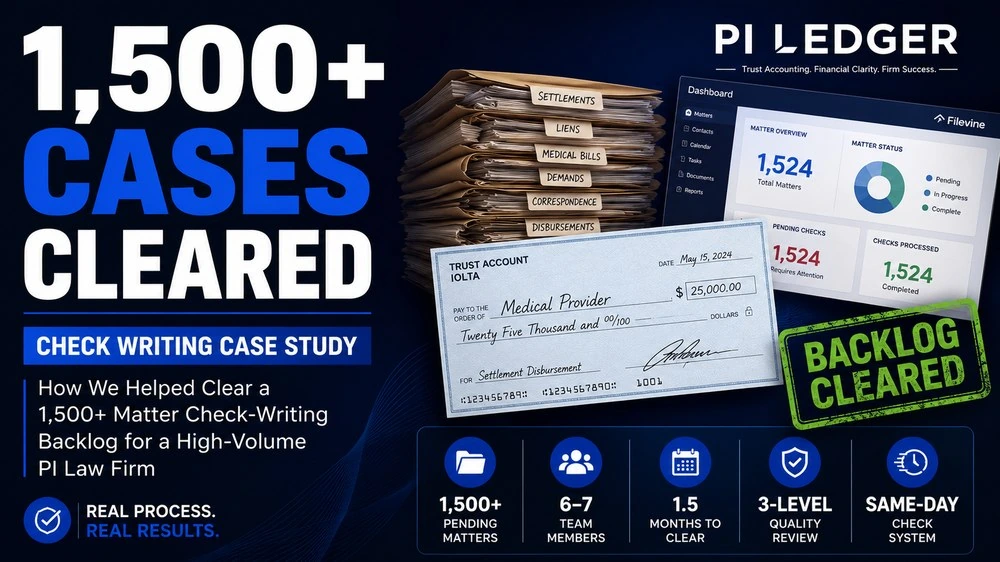
When we started working on check writing for the firm, the situation was already under pressure.
For the last 5–6 months, the firm had mostly issued only client checks. Only a handful of medical provider checks and referring attorney checks had been issued, and and only when those parties specifically requested the checks.
There were more than 1,500 such cases pending for review and check writing.
There were Bar complaints. There was pressure from the law firm. There was no proper knowledge transfer from the previous accountant. There was no proper check data available in a clean format.
We had to start almost on our own.
We did not start by blindly issuing checks.
We first started by gathering firm-specific policies and understanding the firm’s way of working.
We prepared a full list of all pending cases. Then we segregated those cases based on priority:
- High priority
- Medium priority
- Low priority
This helped us bring structure to the backlog.
We selected the right team for the task and trained them on the firm-specific policies and knowledge.
This was important despite the pressure.
When there is pressure, it is tempting to start issuing checks immediately. But in check writing, especially where IOLTA and settlement money are involved, starting without understanding the firm’s policy can be fatal in the long run.
Once the team was ready with the firm’s policies and process, we started cleaning the check writing backlog.
During the backlog cleanup, we followed a three-level review process:
1. Preparer
The preparer’s role was to prepare the check writing work based on the final payout, trust accounting details, and supporting documents.
The preparer checked the matter, payee, amount, payout document, supporting evidence, and accounting treatment.
2. Reviewer
The reviewer checked whether the preparer had done the work correctly.
This included reviewing the supporting documents, amount calculation, payee details, matter reference, and check treatment.
3. Closer
The closer gave the final confirmation before the check was treated as ready.
The closer’s role was to confirm whether everything was absolutely correct.
Dealing with money does not require haste. It requires discipline. We followed this system despite the pressure.
During the process, we found many mistakes from the past accounting work.
In some cases, one due payment had effectively been paid twice because the client defrauded the firm and encashed checks multiple times.
We also found many cases where only the client checks had been issued by the previous accounts payable manager, while the remaining checks for that matter were still pending.
We identified those cases, reviewed the matter records, and issued the remaining checks required for those matters.
We also devised a reporting process for the bank’s Positive Pay system.
This reporting was done every day.
Positive Pay reporting became an important part of the control process because it helped the firm report issued checks to the bank and reduce check-related risk.
In this case, the client maintained its own internal report where the CFO wanted all cleared cases to be reported into a revenue sheet.
This report recorded details such as:
- Business done in each month
- Fees realized
- Fees shared with referring attorneys
- Which referring attorney brought how much business
- Other revenue-related internal tracking
That reporting had been pending for almost a year.
We checked each and every case and updated the revenue reporting sheet accordingly.
During the process, we also set up a call with the Fuel Digital team, which takes care of the Filevine-QBO integration.
We highlighted issues to their team, and they helped resolve them.
We also asked them to change various underlying settings.
For example, our client was not booking everything into trust liability. They were creating separate accounts such as:
- Client medical expense
- Client payments
- Referring attorney checks
We changed the setting in such a way that the client could get the right bifurcation, while at the same time everything was booked properly into trust liability.
This helped improve the trust accounting structure and made reconciliation cleaner.
We created various templates during the process.
These included:
- Memo templates
- Address-checking templates for each check type
- Templates for checking underlying documents for the name on the check
- Templates for determining whether the check amount is correct
- Templates for firm-specific review process
Every client differs. So the template cannot be fully generic. Each firm needs its own check writing template based on its policies, software setup, and internal process.
During the process, we also helped the firm devise a policy for clearing operating checks.
Earlier, the firm had a rough operating policy or way of doing things, but it was not clean and clear. It had several issues.
We worked with the CFO and helped devise a complete operating check policy.
We also made sure that everyone followed the policy before asking for checks from the operating account.
It took around 1.5 months of constant work to clear the backlog.
At any given time, 6–7 team members were involved in the process.
This case showed us that check writing for a personal injury law firm is not just a clerical task.
It is connected with:
- Client payouts
- Medical provider payments
- Referring attorney payments
- IOLTA accounting
- Trust liability
- Filevine-QBO integration
- Positive Pay reporting
- Revenue reporting
- Operating account policy
- Internal controls
- Monthly reconciliation
The backlog was large. The pressure was real. The data was not clean. But we built the process step by step, trained the team, followed a three-level review system, created templates, improved the Filevine-QBO setup, and cleared the backlog.
This is the kind of backend check writing process PI Ledger is built for.